At peak right now: Strawberries, Peas, Lettuce. Head to a farmers market or your CSA to find them fresh.
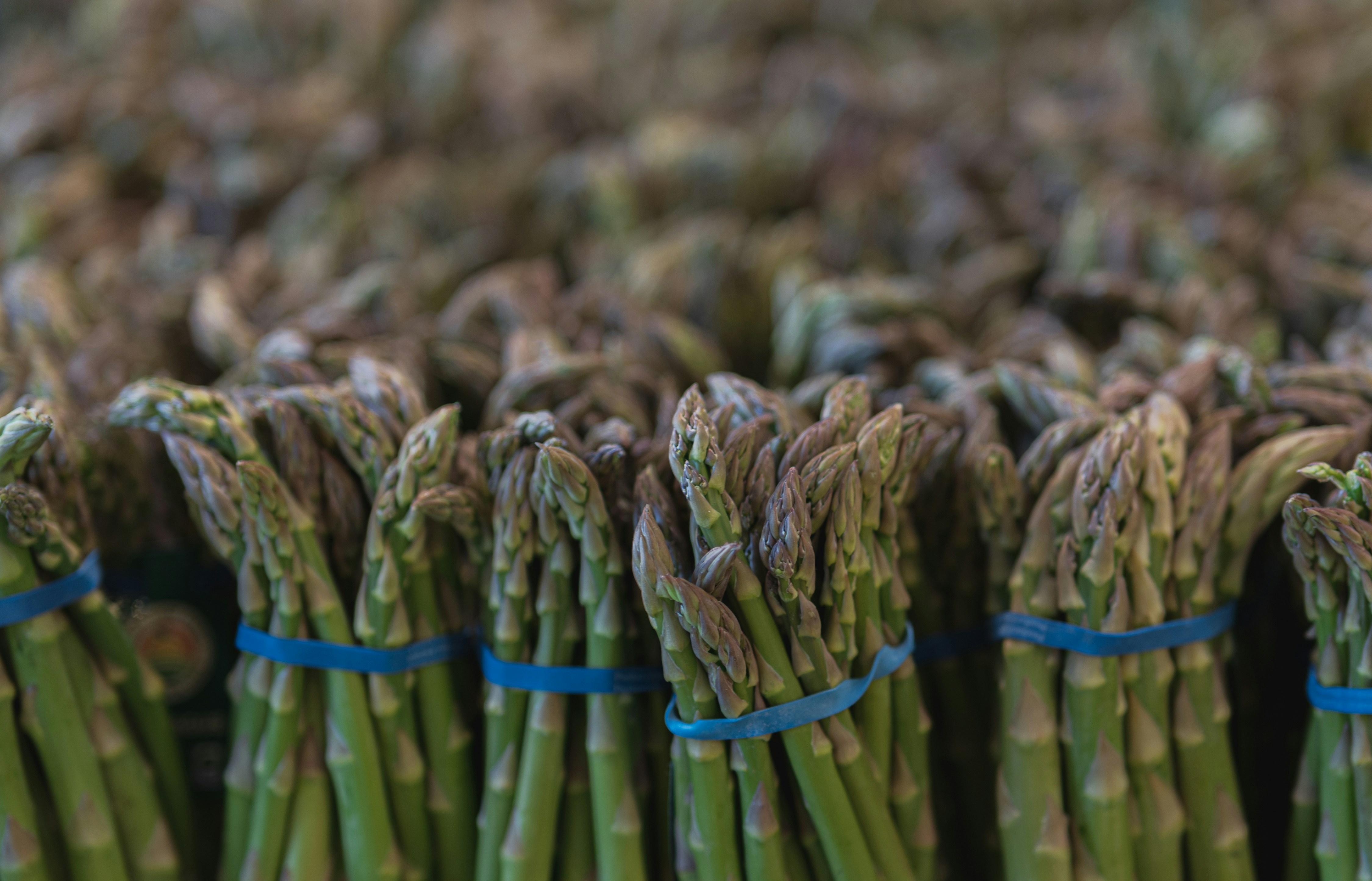
Asparagus at a Maryland farm stand in late April is about as close to a seasonal event as vegetables get. The spears go from soil to market in the same morning, and you can tell. The cut ends are still moist, the tips tight and almost purple at the edges, and when you snap one raw it makes a sound that grocery store asparagus stopped making somewhere in the cargo hold between Lima and Baltimore. The imported stuff tends to arrive in those rubber-banded pencil bundles, uniform and slightly exhausted. Local spears come in a range of thicknesses, a little dirt still on them sometimes, and they cook faster than you expect because they haven't lost moisture sitting in a cold chain for two weeks.
The reason asparagus season feels urgent is that it actually is. The plants are perennial, which means a farmer who puts in an asparagus bed is making a long commitment. You plant crowns, typically one-year-old root systems, and then you wait. The first year you don't harvest at all. The second year you might take a few spears just to taste. By the third year you can start harvesting in earnest, but the bed is still establishing itself, and a full productive planting takes closer to four or five years to hit its stride. Farms like Butler's Orchard in Germantown and a handful of Eastern Shore operations have beds that have been going for decades. The patience required is one reason asparagus isn't grown more widely, and it's part of why local spears cost more than the Peruvian bundles at the grocery.
The season ends quickly because of how the plant works. When temperatures rise in late May, the spears that would have become stalks start growing too fast to harvest and fern out into their feathery summer foliage. That foliage is what feeds the crown for next year's crop, so farmers let it go. You get maybe four to six weeks of harvest, and then it's over until the following spring. Some years a warm April rushes everything and you barely get May. Other years a cool spring stretches the window a little, and you find good asparagus at market into early June.
On thickness: fatter spears are not better. They come from older, more established crowns, which is why you tend to see them at farms with mature beds, but a pencil-thin spear from a good plant is just as tender and more concentrated in flavor. Thick spears benefit from peeling the bottom inch or two of stalk with a vegetable peeler, which removes the fibrous outer layer without wasting the interior. Thin ones don't need it. Both do well roasted at high heat with olive oil and salt until they blister slightly, or blanched just until the color deepens and served with something sharp, a good vinegar, capers, a hard-boiled egg. The window to cook them this way is short enough that it's worth going to the market twice.
A few producers worth knowing about this week.
Five generations of the Jones family have been growing fruits and vegetables for Harford and Baltimore County shoppers, and their Edgewood farm market on Philadelphia Road (just off I-95 Exit 77) reflects that depth of experience. The season runs April through December and includes CSA shares, u-pick strawberries, a pumpkin patch, and Christmas trees, with a second location on Route 543 in Street. If you have kids, their educational field trips are worth a look alongside the market visit.
Running since 1977 under the Fallsway overpass at Saratoga and Holliday Streets, the Baltimore Farmers' Market is Maryland's largest, operating every Sunday from April through December. Managed by the Baltimore Office of Promotion & The Arts, it brings together local growers, food vendors, artisans, and performers in a stretch of downtown Baltimore that reliably draws a crowd. If you're new to shopping local in the city, this is the natural starting point.
Ritter Farm in Sykesville raises a notably diverse roster of pasture-raised meats on their family homestead, including Berkshire pork, Blackbelly lamb, and grass-fed and finished Black Angus beef alongside poultry, duck, quail, turkey, and eggs. Everything is non-GMO, and the farm sells direct, so you are buying cuts that came from animals raised on their own River Road property. If you have been looking for a single Howard County source for both everyday staples like bacon and ground pork and more special-occasion cuts like lamb chops, Ritter Farm is worth a close look.
Calvert's Gift Farm has been growing certified organic fruits and vegetables on seven acres in Sparks since 1995, when Jack and Beckie Gurley established what has become one of Baltimore County's longest-running organic operations. Members can access their produce through a CSA or an online market, and the farm also appears at the Bel Air farmers market. Nearly three decades of consistent, certified organic production in the same place speaks for itself.
East Rivendell Farm in Damascus is part of Three Farmers CSA, a collaboration between East Rivendell, Love & Grit Farm, and Giovanni's Organic Farm that pools the strengths of three Montgomery County growers. The farm raises goats and produces organic eggs, and also offers handmade goat milk soap through their online shop. Shares for the 2025 CSA season are now open for registration.
Visit website →Tucked along Belair Road in Kingsville, Butcher & Bay is a family-owned market specializing in local grass-fed beef that goes through a 35-day in-house dry-aging process before it ever reaches the case. That extended aging deepens the flavor in ways that standard supermarket beef simply cannot match. Beyond the beef, the shop rounds out its offerings with seafood, deli salads, and baked goods, making it a solid one-stop for a quality weeknight meal.
TLV Tree Farm , short for Triadelphia Lake View Farm , has been in the Brown family since 1896, when it began as a dairy operation on Triadelphia Mill Road in Glenelg. Today, Linda and James Brown grow vegetables and offer a CSA, with the farm stand open Saturdays from 10am to 2pm. You can also find them at Howard County farmers markets, carrying on more than a century of family stewardship on the same land.
Heyser Farms has been a roadside institution on New Hampshire Avenue in Silver Spring for generations, offering fresh produce, eggs, butter, buttermilk, and their award-winning apple cider pressed right on site. The farm market runs Monday through Saturday year-round, and spring brings starter herbs, vegetable plants, and perennials alongside fresh seasonal produce. Come fall, they round out the calendar with turkeys and Christmas trees.
Know a farm, market, or maker we're missing?
Submit a Listing