At peak right now: Oysters, Ramps. Head to a farmers market or your CSA to find them fresh.
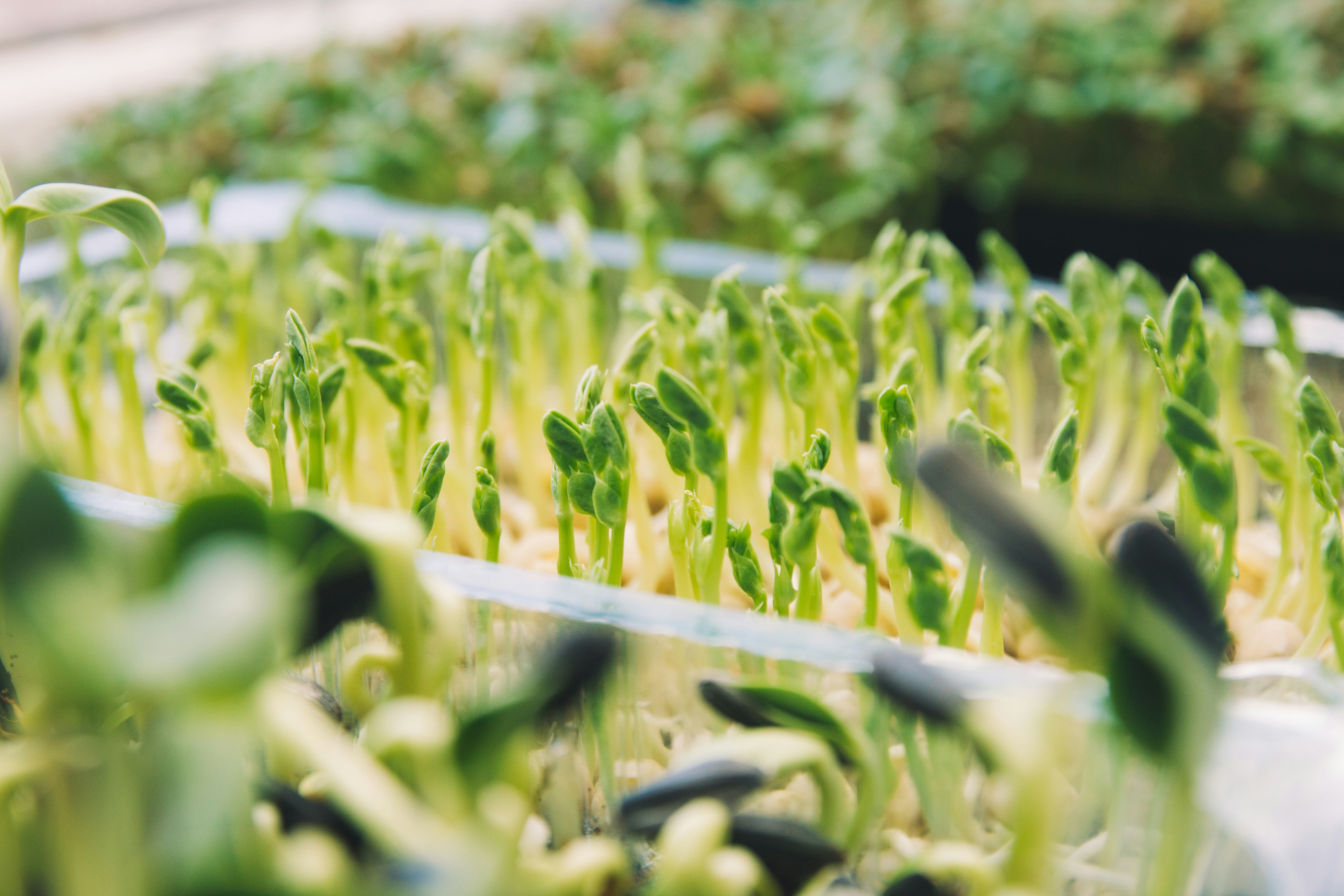
At the end of January, most Maryland farmers market tables have root vegetables, storage squash, dried beans, and maybe some hoophouse greens if the grower has been lucky with the weather. Then there's usually one table with trays of dense, vivid green shoots, the stems still pale at the base where they were cut just above the growing medium. These are microgreens, and they're one of the only crops at a winter market that were in the ground less than two weeks ago. Radish microgreens taste sharply of radish, more concentrated than the full root, with a peppery heat that builds at the back of the throat. Sunflower shoots are nutty and substantial, almost like a seed you can chew through. Pea shoots have that specific sweetness that mature snap peas only hint at.
The reason these show up in February when almost nothing else does is that they're grown entirely indoors under fluorescent or LED grow lights, in shallow trays, on heat mats if the grower is careful about germination temperature. There's no dependence on soil temperature, no waiting for frost dates, no hoophouse that might lose its plastic in a windstorm. A grower with a spare basement or a climate-controlled garage can run continuous trays year-round, staggering plantings so there's always something at the week-and-a-half or two-week mark ready to harvest. This has made microgreens a practical entry point for a lot of small urban and suburban growers in the Baltimore and DC metro region, people who don't have acreage but who have a serious interest in producing food and selling it locally. If you've been to a winter market at Baltimore Farmers' Market and Bazaar, or the Waverly market, or any of the indoor winter markets that counties run through the colder months, you've almost certainly walked past a microgreens grower without fully registering what you were looking at.
The nutritional density argument gets made a lot with microgreens, and the research does support it. Seedlings at the cotyledon stage, before the first true leaves emerge, are drawing on the energy stored in the seed and haven't yet spread it out across a full-sized plant. Some varieties have measurably higher concentrations of vitamins and antioxidants per gram than their mature counterparts. But the more immediate reason to buy them in winter is that they're fresh in a way that almost nothing else at a January market can be. The flavor is bright and aggressive and alive in a way that's hard to get from anything that's been in storage.
They work mixed into a salad with whatever storage vegetables you've roasted, laid over eggs, tucked into a grain bowl that would otherwise be texturally monotonous. Radish microgreens on avocado toast have become a cliche, but the combination works because the heat cuts the fat cleanly. The growers selling them at winter markets are often doing it as a small but serious operation, and most of them are happy to tell you what's coming in the next week if you ask.
A few producers worth knowing about this week.
Ritter Farm in Sykesville raises an impressive range of non-GMO, pasture-raised meats, including Berkshire pork, Blackbelly lamb, and grass-fed and finished Black Angus beef alongside poultry that spans chicken, duck, quail, and turkey. The farm sells at farmers markets and direct, making it a solid one-stop source for Howard County households looking to stock a freezer with responsibly raised protein. Their Berkshire bacon and Blackbelly lamb chops are among the standout cuts worth seeking out.
Open Barn Farm in Woodbine raises grass-fed beef and pasture-raised pork using regenerative practices, and they've built a distribution model designed to make weekly access practical. Customers can order for pickup at drop locations across Maryland, Virginia, and D.C., with delivery running weekly or biweekly depending on your area. They also produce tallow and lard, which puts the whole animal to use in a way that's increasingly hard to find from a local source.
Thanksgiving Farms in Adamstown sits on 57 acres along Buckeystown Pike and manages to be a working CSA, orchard, nursery, and community gathering spot all at once. Their marketplace pulls in products from local artisans alongside the farm's own fruits, vegetables, and unusual plant varieties. On Fridays and Saturdays, locally brewed beer, food trucks, and live music make it a legitimate destination rather than just a pickup stop.
Prosperity Acres in Sunderland raises pasture-roaming beef and goat on a Southern Maryland farm, selling both in bulk cuts , whole, half, or quarter , as well as on the hoof. Animals are raised without added hormones or antibiotics, and the farm also produces raw goat milk marketed for pets. If you've been looking for a local source for goat meat in Calvert County, this is a practical place to start.
Tucked into a historic building along Old National Pike in New Market, Lighthouse Seafood and Deli has been a reliable stop for central Maryland seafood lovers since 2005. They stock 100% Maryland crab meat alongside fresh and frozen fish, and the carryout deli means you can grab something hot on your way home. For Frederick County residents who don't want to drive to the Bay for a quality seafood fix, this is a solid neighborhood option.
Cove Run Farms is a 160 acre dairy farm nestled in a beautiful cove right outside of Accident, Maryland. With 140 registered Holstein cows, 155 heifers and calves, horses, dogs, cats, sheep, a goat, a
Visit website →Summer Creek Farm in Thurmont holds the distinction of being the largest certified organic farm in Frederick County, growing vegetables, grain, and eggs under full organic certification. Beyond produce, they manufacture their own line of organic soil mixes, coir blends, and growing supplies for both wholesale growers and home gardeners. If you're sourcing organic eggs or vegetables in the Frederick area, Summer Creek is a well-established operation with the scale and credentials to back it up.
Nestled among the dairy farms and wheat fields of Frederick County, Elk Run Vineyards has been producing wine in Mount Airy since 1983, when Fred and Carol Wilson and Neill Bassford founded what has grown into one of the most decorated wineries on the East Coast. The property itself carries deep history , the land grant traces back to the King of England, and the winemaker's home dates to 1756. More than 800 awards later, Elk Run remains a benchmark for what Maryland wine can be.
Denizens Brewing Co. is a Prince George's County brewery with deep roots in the Silver Spring and Riverdale Park communities. Founded by two women, Denizens has built a reputation for approachable, well-made beers — from crisp lagers to robust stouts — alongside a genuine commitment to local sourcing and community. Their Riverdale Park location sits in the heart of one of the county's most food-forward neighborhoods, making it a natural fit for anyone who shops the nearby farmers markets and wants to close the loop on a local afternoon.
Visit website →Know a farm, market, or maker we're missing?
Submit a Listing